2026 International Seminar Series on Emerging Technologies in Cyber-Physical Systems (CPS)
Obuda University, John von Neumann Faculty of Informatics
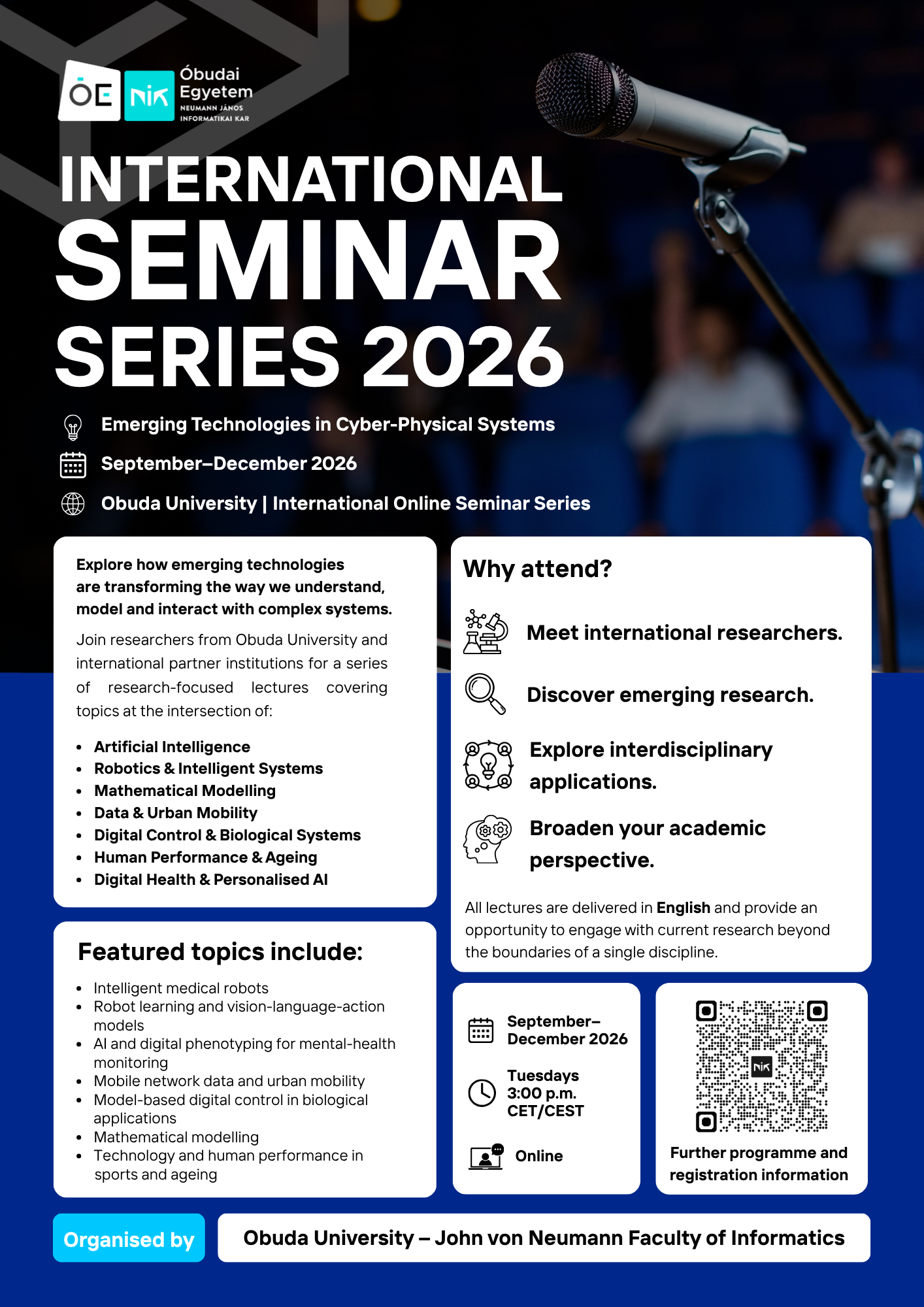
Following the successful previous editions, Obuda University is pleased to announce the 2026 International Seminar Series on Emerging Technologies in Cyber-Physical Systems (CPS).
The 2026 series brings together researchers and academics from Obuda University and international partner institutions to explore emerging technologies, methods and applications at the intersection of artificial intelligence, robotics, mathematical modelling, data-driven systems and human-centred technologies.
Across the autumn semester, the seminar series will offer a diverse programme of research-oriented lectures addressing how intelligent computational and cyber-physical systems can be developed, modelled and applied to complex real-world challenges. The programme ranges from urban mobility and mobile network data to intelligent medical robots, biological applications of digital control, mathematical models, robot learning and vision-language-action models, as well as emerging applications in human performance, ageing and personalised mental-health monitoring.
The series provides an opportunity for students and researchers to gain insight into current research beyond the boundaries of individual disciplines and to engage directly with international experts working at the forefront of their fields.
Course objectives
The seminar series aims to:
- introduce participants to current research and emerging developments in cyber-physical and intelligent systems;
- demonstrate how advanced computational methods can be applied to complex real-world problems;
- explore interdisciplinary connections between artificial intelligence, robotics, modelling, data science and human-centred technologies;
- provide insight into current research approaches, challenges and applications from different scientific perspectives;
- encourage international academic exchange and dialogue between students, researchers and participating institutions;
- develop participants’ ability to engage with research-oriented presentations and scientific discussions in English;
- encourage critical thinking about the opportunities, limitations and wider implications of emerging technologies.
Details
- Language: English
- Prerequisites: Advanced English skills
- Format: International online seminar series
- Weekly Commitment: 1 to 2 hours
- Period: September–December 2026
- Lecture time: Generally Tuesday 3:00 p.m. CET/CEST, but deviation from is possible, please check the spreadsheet for details
- Target audience: MSc and PhD students, researchers and other interested participants
- Assessment: Online examination
- Exam: Details will be available in December
Further information about registration, participation and the individual lectures will be provided as the programme is finalised.
2026 Programme
The 2026 autumn programme consists of a series of international lectures taking place from September to December 2026. Unless otherwise indicated, lectures are scheduled for 3:00 p.m. CET/CEST, with an equivalent US Eastern Time of 9:00 a.m.
The first lecture will take place on 29 September, and the final programme, including the respective Microsoft Teams links for each lecture, will be available soon.
Selected topics in the 2026 series
Analysis of Mobility Customs in Urban Areas by Processing Mobile Network Data
Prof. Imre Felde – Obuda University
How can mobile network data help us understand patterns of human mobility and contribute to the analysis of urban environments? This lecture explores the use of large-scale mobility data for understanding movement patterns in urban areas.
Intelligent Medical Robots
Prof. Tamás Haidegger – Obuda University, EKIK
The lecture focuses on intelligent robotic systems in medicine and the role of robotics in addressing complex challenges in healthcare and medical applications.
Recent Trends in Model-Based Digital Control for Biological Applications
Dr. Alessandro Borri – CNR-IASI, Rome, Italy
This lecture explores recent developments in model-based digital control and their application to biological systems, highlighting the interaction between mathematical modelling, control and complex biological processes.
Robot Learning: From Behavioral Cloning to Vision-Language-Action Models
Prof. Juraj Gazda – Technical University of Košice
The lecture examines the evolution of robot learning, from behavioural cloning approaches to emerging vision-language-action models and their potential for developing more capable intelligent robotic systems.
The Nature of Mathematical Models
Prof. Andrea De Gaetano – Obuda University
Mathematical models provide essential tools for representing, analysing and understanding complex systems. This lecture examines the nature and role of mathematical modelling in scientific research.
The Future of Human Performance in Sports and Ageing
Dr. Attila Biró – Obuda University, EKIK
This lecture explores emerging research on human performance, with a particular focus on sports and ageing, highlighting the role of technology and data-driven approaches in understanding human capabilities and their development over time.
Multimodal AI and Digital Phenotyping for Personalized Mental Health Monitoring
Dr. Soumyashree Sahoo – Quinnipiac University
The lecture explores the use of multimodal artificial intelligence and digital phenotyping for personalised mental-health monitoring, demonstrating how diverse sources of digital information can contribute to emerging approaches in health-related applications.
Further lectures and participating institutions will be added to the programme as the 2026 schedule is finalised.
Why join the series?
The 2026 International Seminar Series offers participants the opportunity to:
- learn directly from researchers working on current and emerging technologies;
- discover research topics extending beyond their own field of study;
- explore real-world applications of intelligent and cyber-physical systems;
- develop a broader understanding of interdisciplinary research;
- practise listening to and engaging with scientific discourse in English;
- connect with an international academic community.
The programme is particularly relevant for MSc and PhD students, early-career researchers and others interested in emerging technologies and interdisciplinary research.
Registration and Participation
Registration is only required for students, otherwise by clicking on the respective Teams link you can join the talks.
For more information, please contact:
Ms. Viktoria Tafferner
lecturer, Obuda University
tafferner.viktoria@uni-obuda.hu
We look forward to your active participation in this enriching seminar series, where academia and industry converge to explore the future of Cyber-Physical Systems.
Organised by
Obuda University
John von Neumann Faculty of Informatics
The seminar series brings together academic expertise from Obuda University and international partner institutions, creating a platform for knowledge exchange and interdisciplinary discussion around emerging cyber-physical and intelligent technologies.