2026 International Seminar Series on Emerging Technologies in Cyber-Physical Systems (CPS)
Obuda University, John von Neumann Faculty of Informatics
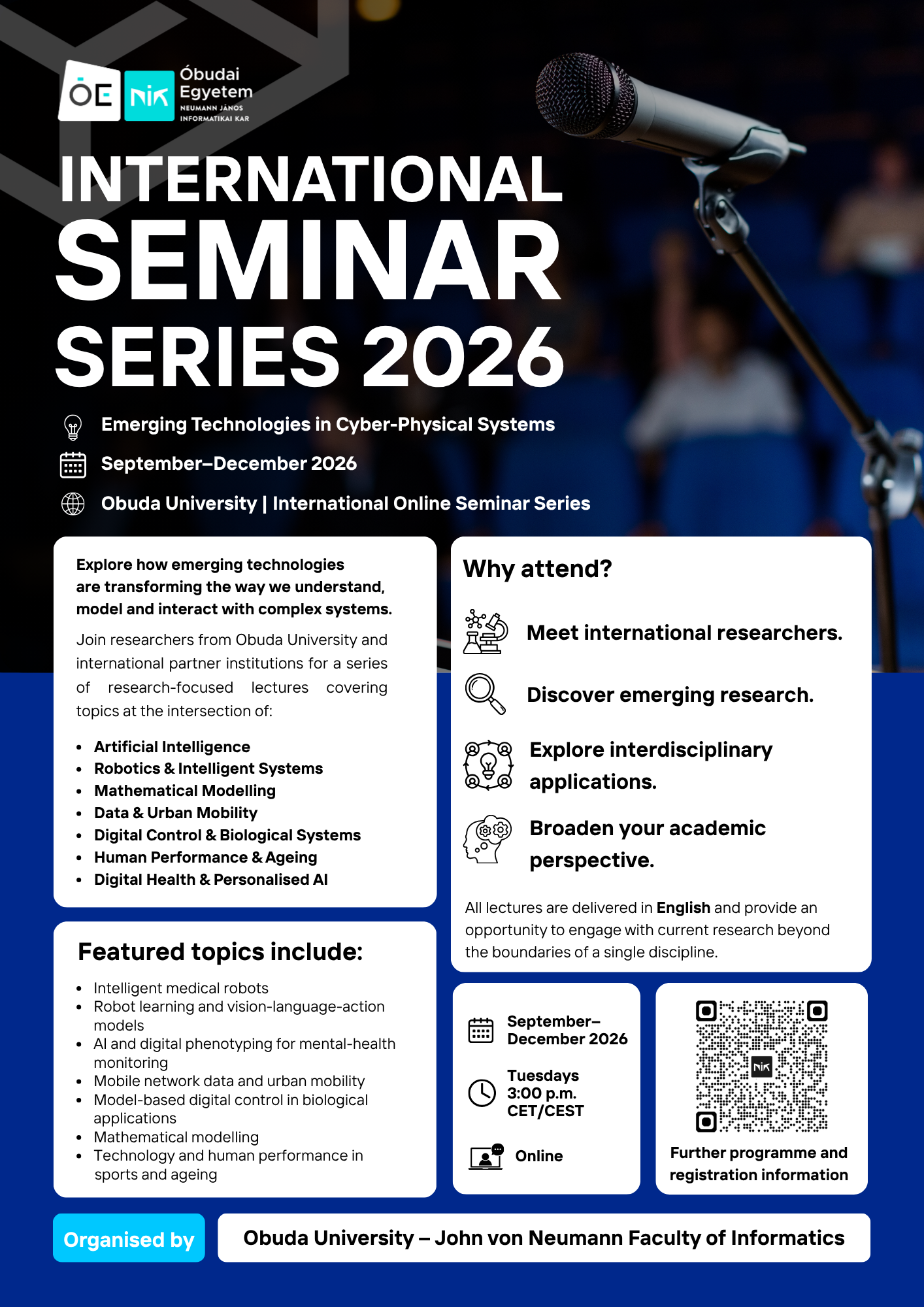
Following the successful previous editions, Obuda University is pleased to announce the 2026 International Seminar Series on Emerging Technologies in Cyber-Physical Systems (CPS).
The 2026 series brings together researchers and academics from Obuda University and international partner institutions to explore emerging technologies, methods and applications at the intersection of artificial intelligence, robotics, mathematical modelling, data-driven systems and human-centred technologies.
Across the autumn semester, the seminar series will offer a diverse programme of research-oriented lectures addressing how intelligent computational and cyber-physical systems can be developed, modelled and applied to complex real-world challenges. The programme ranges from urban mobility and mobile network data to intelligent medical robots, biological applications of digital control, mathematical models, robot learning and vision-language-action models, as well as emerging applications in human performance, ageing and personalised mental-health monitoring.
The series provides an opportunity for students and researchers to gain insight into current research beyond the boundaries of individual disciplines and to engage directly with international experts working at the forefront of their fields.
Course objectives
The seminar series aims to:
- introduce participants to current research and emerging developments in cyber-physical and intelligent systems;
- demonstrate how advanced computational methods can be applied to complex real-world problems;
- explore interdisciplinary connections between artificial intelligence, robotics, modelling, data science and human-centred technologies;
- provide insight into current research approaches, challenges and applications from different scientific perspectives;
- encourage international academic exchange and dialogue between students, researchers and participating institutions;
- develop participants’ ability to engage with research-oriented presentations and scientific discussions in English;
- encourage critical thinking about the opportunities, limitations and wider implications of emerging technologies.
Details
- Language: English
- Prerequisites: Advanced English skills
- Format: International online seminar series
- Weekly Commitment: 1 to 2 hours
- Period: September–December 2026
- Lecture time: Generally Tuesday 3:00 p.m. CET/CEST, please check the spreadsheet for details
- Target audience: MSc and PhD students, researchers and other interested participants
- Assessment: Online examination
- Exam: Details will be available in December
Further information about registration, participation and the individual lectures will be provided as the programme is finalised.
2026 Programme
The 2026 autumn programme consists of a series of international lectures taking place from September to December 2026. Unless otherwise indicated, lectures are scheduled for 3:00 p.m. CET/CEST, with an equivalent US Eastern Time of 9:00 a.m.
| Date | Time in CET/CEST | Time in EST (US) | Institution | Speaker | Title of presentation | Teams |
| 29. 09. 2026 (Tuesday) | 3.00 pm | 9.00 am | Obuda University | Imre Felde | Automated Synthetic Training Analysis of mobility customs in urban area by processing mobile network data | Teams |
| 06. 10. 2026 (Tuesday) | 3.00 pm | 9.00 am | Obuda University, EKIK | Tamás Haidegger | Intelligent medical robots | Teams |
| 13. 10. 2026 (Tuesday) | 3.00 pm | 9.00 am | CNR-IASI, Rome, Italy | Alessandro Borri | Recent trends in model-based digital control for biological applications | Teams |
| 21. 10. 2026 (Wednesday) | 3.00 pm | 9.00 am | Quinnipiac University, USA | Aman Desai | Using AI Agents for Research in Social Sciences | Teams |
| 27. 10. 2026 (Tuesday) | 3.00 pm | 9.00 am | Obuda University | Tamás Ferenci | Methodological challenges of calculating excess mortality | Teams |
| 03. 11. 2026 (Tuesday) | 3.00 pm | 9.00 am | Obuda University | Daniel Drexler | Hybrid modeling of tumor growth under the effect of chemotherapy | Teams |
| 10. 11. 2026 (Tuesday) | 3.00 pm | 9.00 am | Obuda University, CNR-IASI, Rome, Italy | Andrea De Gaetano | The nature of mathematical models | Teams |
| 17. 11. 2026 (Tuesday) | 3.00 pm | 9.00 am | Technical University of Kosice, Slovakia | Frantisek Babic | When Is an AI Model Ready for Clinical Reality? From Prediction to Decision | Teams |
| 24. 11. 2026 (Tuesday) | 3.00 pm | 9.00 am | Technical University of Kosice, Slovakia | Juraj Gazda | Robot Learning from Behavioral Cloning to Vision Language Action Models | Teams |
| 01. 12. 2026 (Tuesday) | 3.00 pm | 9.00 am | Obuda University, EKIK | Attila Biró | The Future of Human Performance in Sports and Ageing | Teams |
| 08. 12. 2026 (Tuesday) | 3.00 pm | 9.00 am | Quinnipiac University, USA | Soumyashree Sahoo | Multimodal AI and Digital Phenotyping for Personalized Mental Health Monitoring | Teams |
| 15. 12. 2026 (Tuesday) | 3.00 pm | 9.00 am | CNR-IASI, Rome, Italy | Simona Panunzi | Parameter estimation for an agent-based model of cell interactions in a microfluidic chip | Teams |
Why join the series?
The 2026 International Seminar Series offers participants the opportunity to:
- learn directly from researchers working on current and emerging technologies;
- discover research topics extending beyond their own field of study;
- explore real-world applications of intelligent and cyber-physical systems;
- develop a broader understanding of interdisciplinary research;
- practise listening to and engaging with scientific discourse in English;
- connect with an international academic community.
The programme is particularly relevant for MSc and PhD students, early-career researchers and others interested in emerging technologies and interdisciplinary research.
Registration and Participation
Registration is only required for OU students, otherwise by clicking on the respective Teams link you can join the talks.
For more information, please contact:
Ms. Viktoria Tafferner
lecturer, Obuda University
tafferner.viktoria@uni-obuda.hu
We look forward to your active participation in this enriching seminar series, where academia and industry converge to explore the future of Cyber-Physical Systems.
Organised by
Obuda University
John von Neumann Faculty of Informatics
The seminar series brings together academic expertise from Obuda University and international partner institutions, creating a platform for knowledge exchange and interdisciplinary discussion around emerging cyber-physical and intelligent technologies.
Course materials
Speakers’ Profiles and Abstracts
Imre Felde
Biography: Prof. Dr. Imre Felde (Engineer of Information Technology) completed his PhD in 2007. He has been working for Bay Zoltán Foundation for Applied Research (BZAKA, Budapest, Hungary) as research fellow between 1995 and 2009. He was General Director of BZAKA between 2010 and 2012. He has been working as Vice Dean (2012-2018) at Obuda Univesity and as Vice rector (2019-2024). He was appointed Full Professor at the John von Neumann Faculty of informatics in 2022. He published more than 240 scientific and technical papers in field of engineering, computer science, mathemathics and process modeling.
Title: Analysis of mobility customs in urban area by processing mobile network data
Abstract: Mobile phones and even more, smart-phones, are now fundamental parts of our life, they are practically, always with us, wherever we go, almost as if they were a part of our body. The continuous communication between a device and the Mobile Phone Networks leaves traces at the Operator’s system of our mobility habits. Via these devices, the Mobile Phone Network can ‘sense’ our movements, which is the basis of the “Smart City” concept. In the last two decades show the potential of the human mobility characterization using Call Detail Records (CDR) in epidemiology, sociology and urban planning. The analysis of the human movement patterns on the basis of the CDR data, that makes it possible to examine a very large population cost-effectively resulted a number of discoveries about human dynamics. In addition to, by mixing mobility indicators with external data, the hidden relationship between the daily customs and Socio-Economic Status (SES) of the dwellers could be evaulated.
Tamás Haidegger
Biography: Tamás P. Haidegger holds MSc degrees in Electrical and Biomedical Engineering and a PhD in Medical Robotics from Budapest University of Technology and Economics (BME), and received his habilitation from Óbuda University in 2022. His research focuses on medical technologies, surgical robotics, teleoperation, image-guided therapy, and digital health. He is a professor at Óbuda University, technical lead of medical robotics research at the Antal Bejczy Center for Intelligent Robotics, and director of Initium Venture Labs. He also holds an Adjunct Associate Professor appointment at Queen’s University and is a research area manager at the Austrian Center of Medical Innovation and Technology (ACMIT). He co-founded HandInScan, a university spin-off dedicated to improving hand hygiene in healthcare.An active leader in IEEE and international standardization, he contributes to the development of standards for medical robotics, patient safety, and innovation management. He serves as Co-Editor-in-Chief of Acta Polytechnica Hungarica and holds editorial positions at several leading journals. The author and co-author of over 350 scientific publications, with more than 5,000 independent citations, he is included in Stanford’s Top 2% Scientists list and has received numerous awards, including the Dennis Gabor and Anyos Jedlik Awards. He has also maintained a professional blog on medical robotics for over 15 years at surgrob.blogspot.com.
Title: Intelligent Medical Robots: From Computer-Assisted Interventions to Autonomous Healthcare Systems
Abstract: Medical robotics has evolved from simple telemanipulation platforms to increasingly intelligent systems capable of perception, decision support, and autonomous task execution. This seminar reviews the current state of intelligent medical robots and their role in modern healthcare, with a particular focus on computer-assisted interventions, surgical robotics, rehabilitation systems, and hospital automation. The presentation discusses how advances in artificial intelligence, machine learning, computer vision, and sensor fusion enable robotic systems to interpret complex clinical environments and support healthcare professionals in performing precise and personalized interventions. Key challenges related to safety, reliability, human-machine collaboration, regulatory compliance, and clinical validation are examined. The seminar also highlights emerging trends, including autonomous surgical subtasks, digital twins, shared-control architectures, and data-driven robotic platforms integrated into cyber-physical healthcare ecosystems. Through representative case studies and recent research developments, participants gain insight into how intelligent medical robots are reshaping clinical workflows and expanding the capabilities of healthcare systems.
Alessandro Borri
Biography: Alessandro Borri is a Senior Researcher at the Institute for Systems Analysis and Computer Science “A. Ruberti” of the National Research Council of Italy (CNR-IASI). He received his Ph.D. in Electrical and Information Engineering from the University of L’Aquila in 2011, where he also teaches Systems Biology. His research focuses on hybrid and nonlinear control, systems biology, and mathematical modelling for biomedical applications. He has spent research periods at the University of California, Berkeley and Santa Barbara, KTH Royal Institute of Technology, and Ford Motor Company. He is an IEEE Senior Member and serves on the editorial boards of IEEE Transactions on Automatic Control, IEEE Control Systems Letters, the International Journal of Robust and Nonlinear Control, and PLOS ONE. He co-received the 2018 IET Systems Biology Premium Award.
Title: Recent trends in model-based digital control for biological applications
Abstract: Biological and biomedical systems combine nonlinear dynamics, physiological delays and stringent safety requirements with the sampling and quantization constraints of digital devices. This lecture presents model-based approaches to their control, using the artificial pancreas as a running example. The focus is on three complementary frameworks: symbolic control based on finite-state abstractions, event-triggered control, and assume-guarantee contracts for interconnected systems. Symbolic methods support controller synthesis from logical and temporal specifications. Event-triggered strategies reduce unnecessary control updates while accounting for digital implementation constraints. Assume-guarantee contracts enable compositional analysis and decentralized design by relating local subsystem requirements to global behaviour. The lecture also discusses how stabilization and safety can be addressed together, including in nonlinear systems with delays. Compact glucose-insulin models and simulation studies illustrate the application of these methods to automated glucose regulation. The aim is to explain how mathematical models and formal guarantees can inform the design of resource-aware biomedical cyber-physical systems.
Aman Desai
Short Bio: Aman Desai is an Assistant Professor of Economics and Data Science in the College of Arts and Sciences at Quinnipiac University, where he teaches principles of microeconomics and macroeconomics, econometrics, and machine learning. He earned his PhD in Economics from the Graduate Center at the City University of New York (CUNY) and was a junior scholar at the Stone Center on Socio-Economic Inequality in New York City. His research examines how labor markets, education, household resources, and social institutions shape economic inequality, mobility, and opportunity. Working at the intersection of labor economics, education economics, econometrics, and data science, he uses causal inference and machine-learning methods to study income, wealth, consumption, employment, and disparities across demographic groups.
Abstract: This lecture explores how AI agents can support and enhance different stages of the social science research process. It introduces the concept of AI agents and examines their potential applications in tasks such as literature exploration, data collection, analysis, synthesis, and research planning. Particular attention is given to how researchers can effectively collaborate with AI agents while maintaining methodological rigour, critical thinking, transparency, and research integrity. The lecture also considers current limitations and challenges, including reliability, bias, verification of AI-generated outputs, and responsible use in academic research.
Tamás Ferenci
Short Bio: Tamás Ferenci earned his degree with honors in Computer Engineering, specializing in Artificial Intelligence, from the Budapest University of Technology and Economics (BME) in 2009. He also holds a degree in Biomedical Engineering with honors (2010, jointly from BME and Semmelweis University), and degrees in Economics (BA with honors in 2010, MSc in 2013, both from Corvinus University of Budapest), as well as in Applied Mathematics with a specialization in Stochastics and a focus on Multivariate Statistics (MSc with honors, 2013, BME). He obtained his PhD with summa cum laude honors from biostatistics at Obuda University in 2013. He obtained his habilitation in 2019 and was appointed as a full professor in 2025. He is currently the head of the Biostatistics and Epidemiology Research Group at the Physiological Controls Research Center of Obuda University, in addition, he is a part-time full professor at the Department of Statistics at Corvinus University of Budapest. His research areas include biostatistics, pathophysiological modeling, and the critical evaluation of medical research.”
Abstract: Measuring the burden of an epidemic is riddled with intricate methodological challenges. Various burden measures — including reported cases, reported deaths, and death certificate data — all have their characteristic advantages and weaknesses. Excess mortality is a robust, alternative metric that remains relatively insensitive to testing intensity and cause-of-death classifications, though it functions as a gross indicator capturing all direct and indirect effects of a pandemic, among other problems. One of these is its sensitivity and vulnerability to forecasting baseline mortality. These questions can be investigated using simulation with synthetic data, shedding light on the optimal choice of parameters, improving our ability to quantitatively monitor ongoing events causing mortality that are hard to track with traditional tools.”